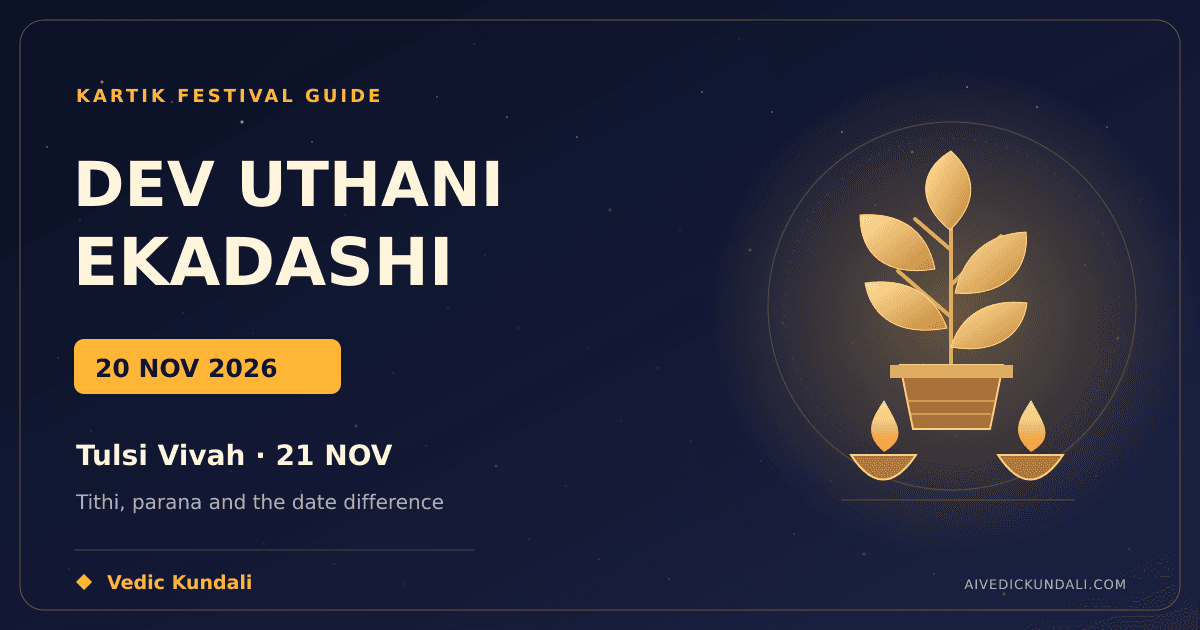
Dev Uthani Ekadashi 2026 falls on Friday, 20 November for the Smarta observance and Saturday, 21 November for the Vaishnava or Gauna observance. Tulsi Vivah is listed on Saturday, 21 November. These dates follow the New Delhi calendar published by Drik Panchang. The two Ekadashi dates reflect different observance rules, so check which tradition your household or temple follows.
The important detail for this year is the fast-breaking time. For the 20 November observance, Delhi's listed parana is 1:11 PM to 3:18 PM on 21 November, rather than an early morning window. All clock times below are New Delhi local time, Indian Standard Time, UTC+5:30. Source: Drik Panchang's 2026 Prabodhini Ekadashi calculation.
Dev Uthani Ekadashi 2026 dates at a glance
| Occasion | Date | What the date identifies |
|---|---|---|
| Smarta Dev Uthani Ekadashi | Friday, 20 November 2026 | The first fasting date in the Delhi listing |
| Vaishnava or Gauna Dev Uthani Ekadashi | Saturday, 21 November 2026 | The alternative observance under Vaishnava rules |
| Tulsi Vivah | Saturday, 21 November 2026 | The Tulsi marriage festival in the Delhi listing |
| Parana after the 20 November fast | Saturday, 21 November 2026 | The listed afternoon fast-breaking window |
| Parana after the 21 November Gauna fast | Sunday, 22 November 2026 | The listed morning fast-breaking window |
Dev Uthani is also called Devutthana Ekadashi, Prabodhini Ekadashi and Dev Uthni Gyaras. Those names identify the same festival. They do not explain the one-day difference between the two observances.
Is Dev Uthani Ekadashi on 20 or 21 November?
Both dates appear in the 2026 calendar. A useful answer must include the observance tradition alongside the date.
A tithi is a lunar phase division. It can begin during the morning and finish the following morning. It does not have to begin at midnight or last exactly 24 hours. Choosing a religious observance day therefore requires rules beyond reading the civil date on which a tithi begins.
Smarta and Vaishnava calendars can select different fasting days from the same astronomical tithi interval. For this festival, the Delhi listing gives 20 November first and 21 November as Gauna. Combining the two into a single unexplained date would hide information that readers need.
For a family calendar, record the tradition with the event: "Dev Uthani Ekadashi, Smarta, 20 November" or "Dev Uthani Ekadashi, Vaishnava, 21 November." Keep the corresponding parana entry attached to it. This prevents someone from taking the fasting date from one calendar and the fast-breaking time from another.
The Hindu calendar helps place the occasion within November. For an observance that has two dates, also check the named tradition in the source you use.
Ekadashi tithi and parana time for Delhi
| Detail | Date and time in IST |
|---|---|
| Ekadashi tithi begins | 20 November, 7:15 AM |
| Ekadashi tithi ends | 21 November, 6:31 AM |
| Hari Vasara ends | 21 November, 12:07 PM |
| Parana for the 20 November observance | 21 November, 1:11 PM to 3:18 PM |
| Parana for the 21 November Gauna observance | 22 November, 6:49 AM to 8:56 AM |
The tithi ending, Hari Vasara ending and parana window are three separate entries. 6:31 AM is the end of Ekadashi tithi. 12:07 PM is the end of Hari Vasara. 1:11 PM is the beginning of the listed Smarta parana window.
This distinction explains why a generic instruction to break the fast immediately after sunrise does not match this year's Delhi listing. The selected parana window comes after the Hari Vasara restriction and follows the calendar's observance rules. Its start should not be replaced with either of the other two times.
For Gauna observance, the source specifically notes that Dwadashi ends before sunrise on 22 November. It nevertheless lists a morning parana window for that observance. This is another reason to use the full observance entry rather than inventing a window from a tithi table alone.
Tulsi Vivah 2026 date and Dwadashi timings
Tulsi Vivah is on Saturday, 21 November 2026 in the New Delhi listing. Dwadashi runs from 6:31 AM on 21 November to 4:56 AM on 22 November, in IST. These are tithi boundaries, not a claim that the entire interval is a single puja muhurat. Source: Drik Panchang's Tulsi Vivah calendar.
The festival celebrates the ceremonial marriage of Tulsi with Vishnu, commonly represented by Shaligram, or with Krishna. It is connected with Dev Uthani Ekadashi but has its own festival entry. A family may therefore have an Ekadashi observance and a Tulsi Vivah celebration on different days.
There are regional differences. Drik Panchang describes celebrations on different days within the period from Prabodhini Ekadashi to Kartik Purnima. A temple's announced event can consequently differ from the Dwadashi date shown in a general calendar. Check its own programme before arranging a visit, especially if an invitation uses the broad label "Dev Uthani and Tulsi Vivah."
An invitation is clearest when it states the festival name, civil date, city and ceremony time together. "Tulsi Vivah, 21 November, evening" still needs a specific venue and local schedule.
What Dev Uthani marks in the Hindu calendar
In Hindu tradition, Dev Uthani celebrates Vishnu awakening from his four-month yogic sleep. It marks the end of Chaturmas. The story gives the festival its names associated with awakening.
This is a statement of religious tradition. The dates and tithis are calendar calculations; the meaning attached to them belongs to the observance. Keeping those two parts clear helps explain why a festival date can be calculated precisely while household customs still vary.
For planning the surrounding festivals, see the 2026 Diwali and autumn festival calendar. Our separate Chhath Puja 2026 calendar covers its four days and the distinction between evening and morning Arghya.
Does the wedding season start on Dev Uthani?
Dev Uthani and Tulsi Vivah are associated with the reopening of the wedding season in many communities. That broad cultural description does not make every following day an approved wedding muhurat.
A wedding muhurat is a separate selection. Depending on the tradition, it can consider the local panchanga, the chosen lagna and restrictions such as Guru or Shukra combustion. This article does not calculate a personal wedding muhurat or establish whether those restrictions apply to a particular booking.
Before confirming a ceremony, separate three questions: which festival date your community observes, which wedding dates its calendar accepts, and which practical arrangements work for the couple. A festival overview answers the first question. It cannot settle all three.
Our marriage-timing guide explains the traditional chart factors considered in that different question. Chart interpretation does not guarantee a marriage date or outcome.
Using these times outside Delhi
Tithi boundaries describe an astronomical event. Local sunrise and the rules applied to it help determine observance and parana. Changing the city therefore involves more than copying Delhi's clock times.
For example, a reader in London should select London in a local panchang rather than treat the Delhi afternoon window as a London afternoon window. A reader in Kathmandu also needs the local entry: a timezone conversion changes the displayed clock, but it does not independently calculate the city's parana.
The Panchanga tool provides location-based astronomical context. The observance dates and parana windows in this article are attributed to the named Delhi sources. They are not presented as results produced by that tool's festival-rule engine.
Common questions
When is Dev Uthani Ekadashi 2026?
The Delhi calendar lists 20 November for Smarta observance and 21 November for Vaishnava or Gauna observance. Use the date followed by your household or temple.
When is Tulsi Vivah 2026?
It is listed on 21 November for New Delhi. Regional and temple programmes can use another day within their traditional celebration period.
Is Delhi's parana in the morning on 21 November?
The listed window for the 20 November observance is in the afternoon. Use the detailed table above, including its Hari Vasara entry, rather than a generic morning rule.
Do Dev Uthani Ekadashi and Tulsi Vivah mean the same thing?
They are connected observances with different meanings. Dev Uthani marks Vishnu's awakening in Hindu tradition; Tulsi Vivah celebrates the ceremonial marriage of Tulsi and Vishnu or Krishna.
Can I use these parana times for any city?
Use a local calendar for your city and tradition. Delhi's listing is a location-specific reference, not a universal timetable.
Sources and calculation scope
- Drik Panchang: Prabodhini Ekadashi 2026, New Delhi, observance dates, Ekadashi boundaries, Hari Vasara and both parana windows.
- Drik Panchang: Tulsi Vivah 2026, New Delhi, Dwadashi boundaries, festival date and regional variations.
All quoted clock times use IST. Calendar observance follows the named source's rules; no separate personal muhurat calculation is claimed.