


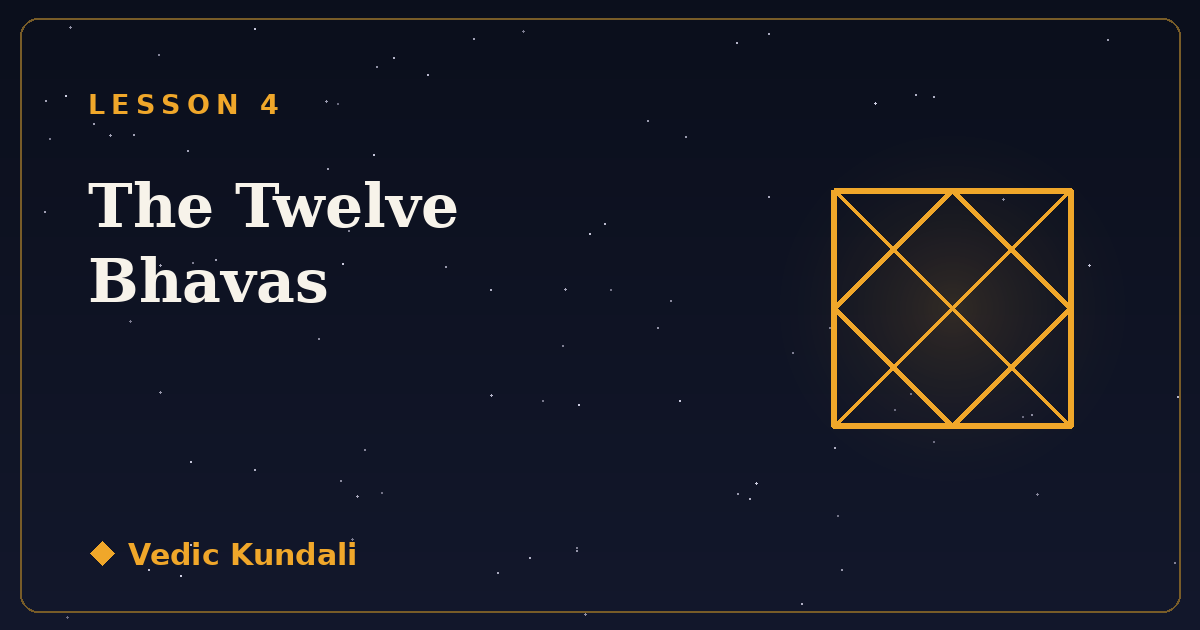
If the signs are the "how" and the planets are the "what", the houses are the "where in life". A kundali is divided into twelve houses (bhavas), and each one governs a specific area of your life. When a planet sits in a house, it directs its energy into that area.
-
1TanuSelf, body, personalityKendra
-
2DhanaWealth, speech, family
-
3SahajaSiblings, courage, communication
-
4SukhaHome, mother, propertyKendra
-
5PutraChildren, creativity, intelligence
-
6AriEnemies, debts, health, service
-
7YuvatiMarriage, partnershipKendra
-
8RandhraLongevity, transformation, secrets
-
9DharmaLuck, dharma, father, learning
-
10KarmaCareer, status, public lifeKendra
-
11LabhaGains, income, friends
-
12VyayaLoss, expenses, foreign, spirituality
What each house governs
| House | Governs |
|---|---|
| 1st | Self, body, personality, health |
| 2nd | Wealth, family, speech, food |
| 3rd | Courage, siblings, communication, effort |
| 4th | Mother, home, property, happiness |
| 5th | Children, intelligence, creativity, romance |
| 6th | Health, enemies, debts, daily work |
| 7th | Marriage, spouse, partnerships |
| 8th | Longevity, transformation, the occult |
| 9th | Fortune, father, dharma, higher learning |
| 10th | Career, status, reputation |
| 11th | Gains, income, friends, desires |
| 12th | Loss, expenses, foreign lands, liberation |
The four most important houses
The 1st, 4th, 7th and 10th houses are called kendras (angles) and are the pillars of the chart, they carry the most weight. The 1st, 5th and 9th are the trikonas (trines), the luckiest houses, connected to fortune and dharma. A planet that connects a kendra and a trikona can form a powerful Raja Yoga.
A quick example
Say a planet sits in your 7th house (marriage). If it is a benefic like Guru (Jupiter), it tends to bless partnerships with wisdom and a good spouse. If it is Mangal (Mars), it can add heat or conflict to relationships unless well handled. The same planet gives very different results depending on the house. You can read any planet in any house on the planet pages, for example Mangal in the 7th house.
Houses vs signs, don't confuse them
A sign is a slice of the zodiac (Mesha (Aries), Vrishabha (Taurus)...). A house is an area of life (self, wealth...). In the next lesson we connect them: the Lagna decides which sign sits on your 1st house, and the rest follow in order.
The four families of houses
The twelve bhavas are grouped into families, and knowing the family tells you how a house behaves before you look at anything else.
| Family | Houses | Nature |
|---|---|---|
| Kendra (angles) | 1, 4, 7, 10 | The pillars. Strength, visibility, action |
| Trikona (trines) | 1, 5, 9 | Fortune, dharma, grace |
| Dusthana (difficult) | 6, 8, 12 | Friction, loss, dissolution |
| Upachaya (growing) | 3, 6, 10, 11 | Improve with time and effort |
Two of these deserve attention. Dusthanas are not simply bad houses. They are where struggle is processed, and a malefic placed there often performs well, because it is given work suited to its nature. Upachayas improve as life goes on, which is why a difficult 6th or a heavy Shani in the 3rd can look worse at twenty than at fifty.
House lords matter more than house occupants
Beginners read what sits in a house. Experienced readers first ask who rules it.
Every house carries a sign, and that sign has a ruler. That ruler is the house's lord, and it carries the house's affairs wherever it goes. If your 10th house is Vrishchik, its lord is Mangal, and your career story follows Mangal around the chart. A 10th house standing empty is not an empty career; you simply read it from its lord.
This single habit, checking the lord before the occupant, resolves most of the confusion beginners have with empty houses.
A chart with the houses numbered
Note that the diamond itself never moves. The house numbers are fixed to their positions in the North Indian chart, and it is the signs that rotate into them depending on your Lagna. That is the reverse of the South Indian style, where the signs are fixed and the houses move.
Reading a house properly
Work through these four in order and you will have covered what matters.
- The house lord and where it sits.
- Any grahas occupying the house.
- Aspects falling on the house, covered in the drishti lesson.
- The natural karaka for that theme. Shukra for marriage, Guru for children, Surya for father.
A house supported on three of these four is strong even if the fourth is weak.
Frequently asked questions
My 7th house is empty. Does that mean no marriage? No, and this is the most common beginner worry. Most houses in most charts are empty, since nine grahas cannot fill twelve houses. Read the 7th lord and Shukra instead. See marriage timing.
Which house is the most important? The 1st, because it holds the Lagna and its lord conditions everything else.
Are the 6th, 8th and 12th houses always bad? No. They are the houses of difficulty, service and release. Strong placements there produce doctors, researchers, healers and people who work well in crisis.
Key takeaways
- Twelve houses = twelve areas of life.
- Kendras (1,4,7,10) and trikonas (1,5,9) are the strongest houses.
- A planet acts on the affairs of the house it occupies.
- Next: the Lagna that anchors the whole chart.
Where to go next
- What each graha actually does once it lands in a bhava: planets in the houses.
- When several grahas occupy the same bhava, read the yuti: conjunctions house by house.
- The house most people ask about first: career and the 10th house.
- The full reference table for every bhava: the twelve houses.