


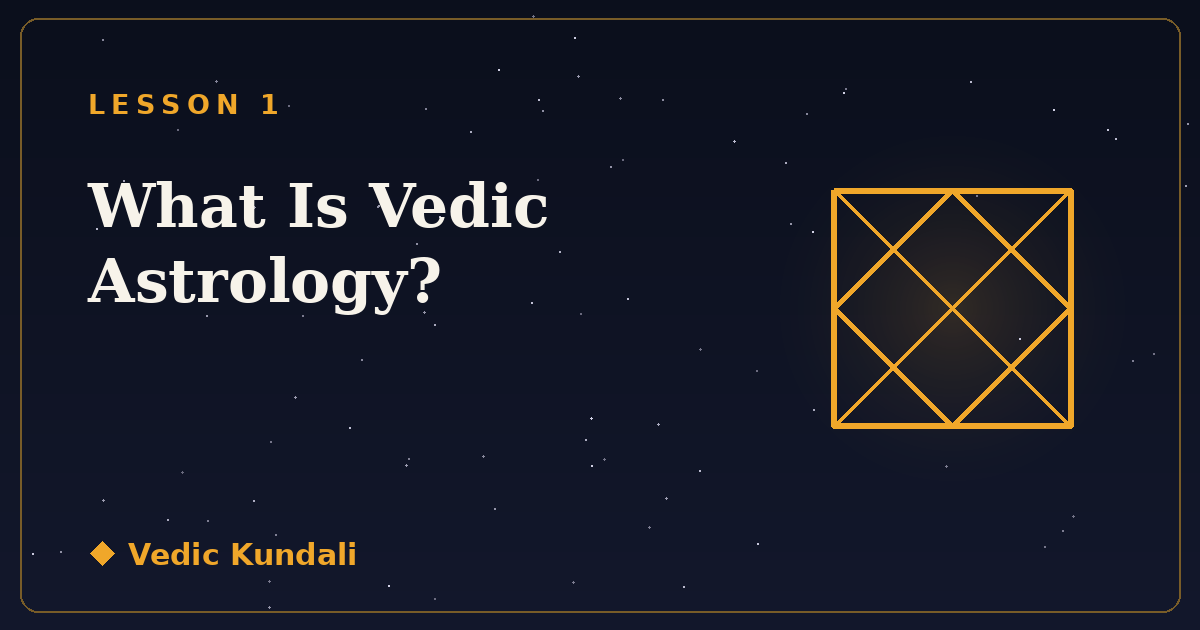
Vedic astrology, called Jyotish ("the science of light") in Sanskrit, is an ancient system from India for understanding your life through the sky. The idea is simple: the exact positions of the Surya (Sun), Chandra (Moon) and planets at the moment you were born form a snapshot, and that snapshot, your kundali (birth chart), is a map of your personality, strengths, challenges and timing.
You do not need to believe anything on faith to start. Think of Jyotish as a language for describing patterns in a life. This lesson gives you the map of the whole subject so the later lessons make sense.
The four building blocks
Almost everything in a kundali is built from four things. We have one lesson on each:
- The 12 Rashis (signs), twelve 30° slices of the zodiac, like Mesha (Aries) and Vrishabha (Taurus). Each has a mood and a ruling planet.
- The 9 Planets (grahas), the Surya, Chandra, Mangal (Mars), Budha (Mercury), Guru (Jupiter), Shukra (Venus), Shani (Saturn), plus Rahu and Ketu (the two lunar nodes). Each planet stands for parts of life.
- The 12 Houses (bhavas), twelve areas of life, from your body and money to marriage and career.
- The 27 Nakshatras (lunar mansions), a finer 27-fold division of the zodiac that adds detail.
A reading is simply: which planet is in which sign, in which house. For example, "Shukra in Tula (Libra) in the 7th house" instantly tells a Jyotishi something about love and marriage.
How is it different from Western (Surya-sign) astrology?
Most people know their Western Surya sign from a newspaper. Vedic astrology differs in three important ways:
| Western | Vedic (Jyotish) | |
|---|---|---|
| Zodiac | Tropical (tied to seasons) | Sidereal (tied to the actual stars) |
| Most important point | Surya sign | Chandra sign and Lagna (rising sign) |
| Main use | Personality | Personality and timing (dashas) |
Because of the sidereal zodiac, your Vedic sign is often the one before your Western sign. So a "Western Simha (Leo)" is frequently a Karka (Cancer) in Jyotish. This is normal and expected.
What can a kundali actually tell you?
A well-read chart can describe your natural temperament, the areas of life that flow easily, the areas that need effort, and, crucially, when things are likely to unfold, through a timing system called dashas (planetary periods). It is a tool for self-understanding and planning, not fixed fate. In Jyotish the chart shows the field; your choices still play the game.
What's next
You now have the big picture. In the next lessons we will meet the twelve signs, the nine planets and the twelve houses one by one, then put them together to actually read a chart.
Where Jyotish comes from
Jyotish is one of the six Vedangas, the limbs of the Veda, and it was preserved as the "eye" of that body of knowledge: the discipline that tells you when to act. Its rules were systematised in texts that practitioners still reason from today, above all the Brihat Parashara Hora Shastra, attributed to Maharishi Parashara.
That matters for a beginner because Jyotish is not a loose tradition of opinions. It is a rule-based system with a written basis, which is why two competent astrologers reading the same chart will usually agree on the main structure even if they emphasise different things.
The three layers of a real reading
Most beginners stop at layer one. A full reading has three.
| Layer | What it answers | Built from |
|---|---|---|
| Structure | What kind of life is this? | Rashis, grahas, bhavas |
| Timing | When does it happen? | Dashas, chiefly Vimshottari |
| Detail | How exactly does it play out? | Divisional charts such as the navamsa |
A chart without timing is a description. Timing is what turns it into something you can plan around, and it is the part that distinguishes Jyotish most sharply from newspaper astrology.
How your chart is actually calculated
Three inputs decide everything: your date, your exact time, and your place of birth. Place fixes the horizon, which fixes your Lagna. Time matters more than people expect, because the Lagna moves through a whole sign roughly every two hours.
Vedic charts use the sidereal zodiac, measured against the actual stars. The gap between the sidereal and tropical zodiacs is called the ayanamsha, currently around 24 degrees. We compute with Drik Siddhanta and the Swiss Ephemeris using the Lahiri ayanamsha, which is the standard in modern Indian practice.
That 24 degree offset is the single reason your Vedic sign is often one behind the Western one. Nothing has gone wrong when that happens.
What Jyotish does not claim
A chart is not a verdict. The classical position is that the chart shows prarabdha, the portion of past action now ripening, and that effort still operates within it. A difficult placement describes a pressure, not a sentence.
Two practical consequences follow. First, be sceptical of anyone reading a single placement in isolation, because Jyotish is a system of cross-checks. Second, be sceptical of fear-based readings. A well-placed Shani builds discipline; a badly handled Guru can make a person complacent. Nothing in the chart is simply good or bad.
Frequently asked questions
Do I need to believe in it to read a chart? No. You can treat Jyotish as a structured language for describing patterns and timing in a life, and judge it on whether the descriptions land.
What if I do not know my birth time? You can still read the Chandra sign and most planetary positions, since those move slowly. You lose the Lagna and the house framework, which is a serious loss. Astrologers sometimes reconstruct a time through birth time rectification.
Is Vedic astrology the same as Indian numerology or palmistry? No. They are separate disciplines. Jyotish is calculated from astronomical positions.
Why is my sign different from what I always thought? Because of the sidereal zodiac and the ayanamsha described above. Your Vedic sign is usually the one before your Western sign.
Key takeaways
- Jyotish reads your life from the sky at your birth.
- The four building blocks are signs, planets, houses and nakshatras.
- The Chandra sign and Lagna matter more than the Surya sign here.
- Vedic uses the sidereal zodiac, so your sign may shift back by one.
Where to go next
- The building blocks in order: the twelve rashis, the nine grahas and the twelve houses.
- A worked walkthrough of a real chart: understanding your Vedic birth chart.
- Reference tables you will keep coming back to: all 27 nakshatras, the nine grahas and planet conjunctions.