Type a date, a time and a city into any kundali app and a chart appears in less than a second. It looks like a black box. It is not. Every number in that chart comes from a short chain of arithmetic that you can follow with a pencil, and at the end of it you can check the result against NASA.
This article slows that second down. We take one real birth, 15 January 2000 at 8:00 am in New Delhi, and walk through each step our own calculation makes, with the actual numbers at every stage. By the end you will know exactly why your Moon sign is what it is, why two websites sometimes disagree about it, and which of the inputs you gave matters most.
The birth we will use
| Input | Value |
|---|---|
| Date | 15 January 2000 |
| Clock time | 8:00 am |
| Place | New Delhi, 28.61° N, 77.21° E |
| Time zone | Indian Standard Time, UTC + 5:30 |
Nothing else goes in. Every planet, house, nakshatra and dasha below is computed from these four lines.
Step 1: turn clock time into world time
Astronomy runs on Universal Time, so the first job is to remove the time zone. 8:00 am IST minus 5 hours 30 minutes is 2:30 am UT on the same date.
This step is where a surprising number of wrong charts begin. India has used UTC + 5:30 since 1947, but Nepal used UTC + 5:30 until 1986 and only then moved to + 5:45, and the countries of the diaspora mostly observe summer time. A birth in Kathmandu in 1984 entered with today's + 5:45 is fifteen minutes out before any astrology has happened. Good software looks up the zone that was in force on the birth date, not the one in force today.
Step 2: count the days
Astronomers count time as a single running number of days, the Julian Day, so that two dates can be subtracted without worrying about months and leap years. 2:30 am UT on 15 January 2000 is Julian Day 2451558.604. Every position below is calculated for that one number.
Step 3: find where each planet actually was
Now the ephemeris does the heavy lifting. Ours is the Swiss Ephemeris, which is built on NASA's Jet Propulsion Laboratory planetary theory. It returns each planet's longitude along the ecliptic, measured from the spring equinox point:
| Planet | Longitude from the equinox |
|---|---|
| Surya (Sun) | 294°14'11" |
| Chandra (Moon) | 31°04'28" |
You do not have to take our word for these. NASA's own JPL Horizons system, queried for the same instant from the centre of the Earth, gives the Sun at 294.23632°, which is 294°14'11", identical to the arcsecond, and the Moon at 31.07477°, which is 31°04'29", one arcsecond away. A second of arc is about the width of a coin seen from four kilometres. This part of a kundali is not a matter of opinion.
Step 4: move from the equinox to the stars
Here Jyotish and Western astrology part company. The longitudes above are tropical: they are counted from the spring equinox, which slides backwards against the stars by about one degree every 72 years. Jyotish counts from a fixed point among the stars instead, so it subtracts the accumulated slide, the ayanamsha.
On 15 January 2000 the Lahiri ayanamsha, the one adopted by the Government of India's Calendar Reform Committee in 1955 and used by most Indian almanacs, was 23°51'27". Subtract it from every planet:
- Sun: 294°14'11" minus 23°51'27" = 270°22'44", which is 0°22' Makar.
- Moon: 31°04'28" minus 23°51'27" = 7°13'01", which is 7°13' Mesh.
Look at the Moon. A Western chart for this birth puts it at 1° Taurus. The Vedic chart puts it at 7° Mesh. Same sky, same instant, different sign, and it is the ayanamsha alone that moves it. This is the single most common reason people find two different Moon signs online.
Step 5: find the lagna
The lagna is the sign rising on the eastern horizon at that moment, so it depends on where on Earth you stand. Three numbers produce it:
- Greenwich sidereal time at 2:30 am UT on this date: 10.09 hours.
- Local sidereal time in Delhi, adding the longitude (77.21° ÷ 15 = 5.15 hours): 15.24 hours, which puts 228.6° of the sky on the meridian.
- The ascendant formula, which combines that meridian point with Delhi's latitude of 28.61° and the tilt of the Earth's axis, gives a tropical ascendant of 305°26'39".
Subtract the same ayanamsha and the lagna is 11°35' Makar. Had the child been born in Kolkata at the same clock time, the horizon would already have turned further and the lagna would be 27° Makar; half an hour later in Kolkata it is Kumbh. The Lagna guide shows those numbers side by side.
Step 6: fill the houses
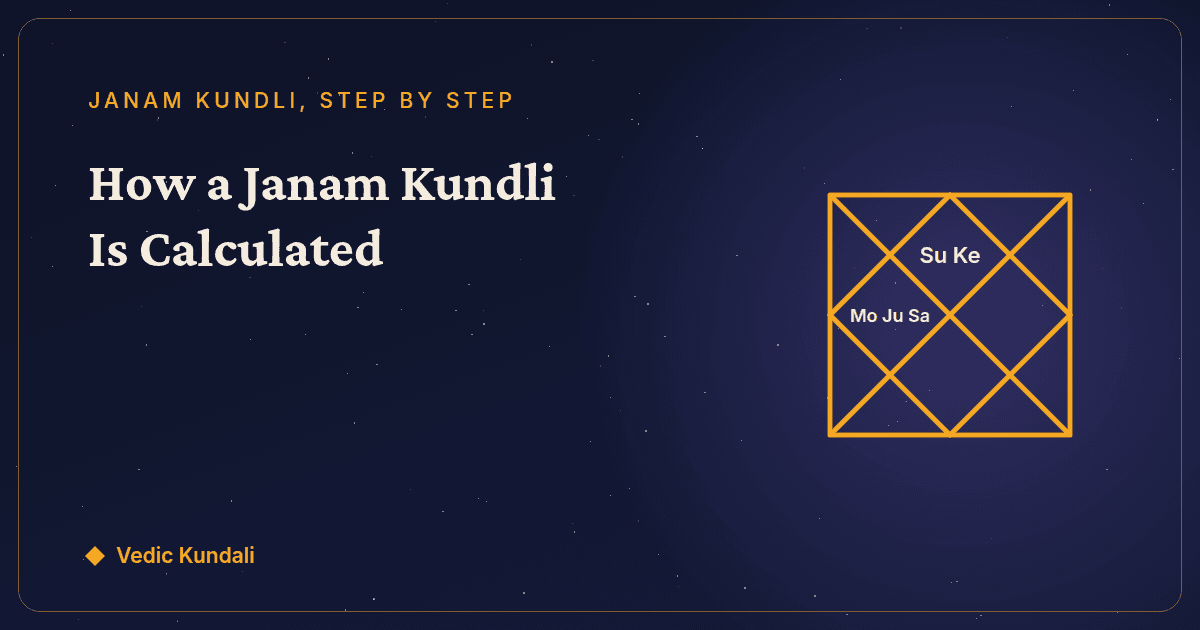
With the lagna in Makar, Makar becomes the 1st house, Kumbh the 2nd, and so on round the zodiac, one sign per house. Each planet falls into the house that holds its sign:
| Graha | Sidereal position | House | Nakshatra and pada |
|---|---|---|---|
| Surya | Makar 0°22' | 1st | Uttara Ashadha 2 |
| Chandra | Mesh 7°13' | 4th | Ashwini 3 |
| Mangal | Kumbh 14°39' | 2nd | Shatabhisha 3 |
| Budh | Dhanu 29°46' | 12th | Uttara Ashadha 1 |
| Guru | Mesh 2°15' | 4th | Ashwini 1 |
| Shukra | Vrishchik 24°14' | 11th | Jyeshtha 3 |
| Shani | Mesh 16°26' | 4th | Bharani 1 |
| Rahu | Karkat 10°27' | 7th | Pushya 3 |
| Ketu | Makar 10°27' | 1st | Shravana 1 |
Step 7: the nakshatra and the first dasha
The Moon at 7°13' Mesh sits in Ashwini, the first nakshatra, which runs from 0° to 13°20' Mesh. It has crossed 7°13' of those 13°20', or 54.1%. Ashwini is ruled by Ketu, so life begins in the Ketu Mahadasha, whose full length is 7 years. The part not yet used is 45.9% of 7 years: 3 years, 2 months and 16 days of Ketu at birth, then Shukra for 20 years, then Surya for 6, and onward through the cycle. The Vimshottari dasha guide walks through that arithmetic on its own.
Why two calculators can disagree
If everything above is arithmetic, why do two websites sometimes give you different charts? Four reasons, in order of how often they matter:
1. The ayanamsha. Lahiri is the Indian standard, but it is not the only one. Here is the same birth under three of them:
| Ayanamsha | Value | Budh | Lagna |
|---|---|---|---|
| Lahiri | 23°51' | Dhanu 29°46' | Makar 11°35' |
| Krishnamurti (KP) | 23°45' | Dhanu 29°52' | Makar 11°41' |
| Raman | 22°24' | Makar 1°13' | Makar 13°01' |
Under the Raman ayanamsha, Budh crosses into Makar and changes house, from the 12th to the 1st. Any planet within a degree or two of a sign boundary is exposed to this, so if a reading surprises you, look at the degrees first.
2. The time zone. As in step 1: a zone applied from the wrong year moves everything.
3. The node. Rahu and Ketu can be computed as the mean node, which moves smoothly, or the true node, which wobbles around it. For this birth the two differ by 0°35'. We use the mean node, the classical choice; near a sign boundary the true node can put Rahu in the neighbouring sign.
4. The birth time itself. The lagna moves about a degree every four minutes. A time rounded to the nearest half hour, which is how many family records were kept, can be fifteen minutes out, enough to move the lagna by four degrees and sometimes into the next sign.
The first three are choices of method, and a good calculator tells you which it has made. The fourth is the only input you control, and it is worth the effort to get right.
Check your own
Every chart on this site is calculated exactly as above: Lahiri ayanamsha, the mean node, one sign per house, and the time zone that applied on your birth date. Create your free Kundali, open the planet table, and you will see the same columns as the table above, filled in for you. If you have a printed kundali from a family astrologer, compare the Moon's degree: if the two agree to within a few minutes of arc, the calculation is right, and any disagreement in the reading is a matter of interpretation, not arithmetic.
Sources
- Planetary positions: the Swiss Ephemeris, Astrodienst.
- Independent check of the Sun and Moon: NASA JPL Horizons, observer ecliptic longitude, geocentric, 2000-01-15 02:30 UT.
- Ayanamsha systems compared: the Swiss Ephemeris documentation on sidereal modes.