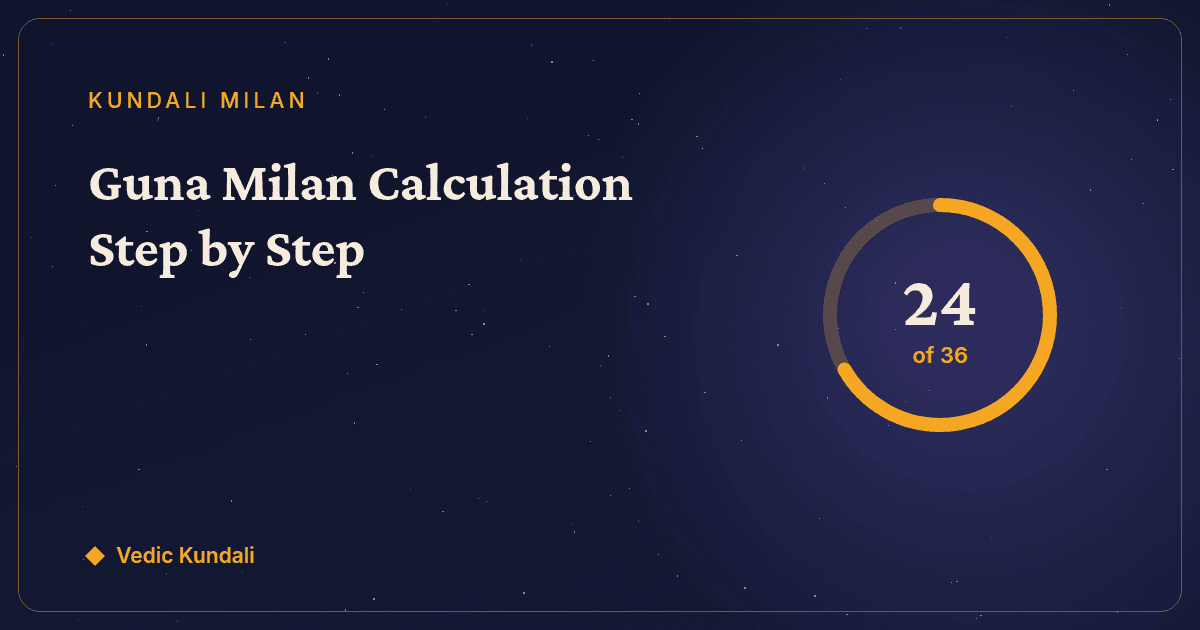
Twenty-four out of thirty-six. Families have said yes to marriages on less and no to marriages on more. The number arrives looking like a verdict, and most people never see what is inside it.
What is inside it is eight small calculations, each worked from just two facts: where the bride's Chandra (Moon) was at her birth, and where the groom's was at his. Nothing else in either chart enters the score. Once you can do the eight steps yourself, which takes about ten minutes, you will see exactly what a Guna Milan score measures, and the much longer list of things it never looks at.
Here is one real calculation, koota by koota.
The two Moons
The couple is an example. The births are real dates, computed with the Swiss Ephemeris and the Lahiri ayanamsha:
| Groom | Bride | |
|---|---|---|
| Born | 26 June 1995, 7:40 am IST | 25 November 1997, 6:20 pm IST |
| Chandra rashi | Vrishabh, 19°03' | Kanya, 17°41' |
| Janma Nakshatra | Rohini (4th), pada 3 | Hasta (13th), pada 3 |
| Rashi lord | Shukra (Venus) | Budh (Mercury) |
Every koota below is read from this table. If you know your own Moon's rashi and nakshatra, you can follow along with yours.
1. Varna: 1 point possible
Each rashi belongs to one of four varnas. Vrishabh and Kanya are both Vaishya signs. The rule gives the point when the groom's varna is equal to or higher than the bride's, and equal counts.
Score: 1 of 1.
2. Vashya: 2 points possible
Vashya sorts the rashis into five kinds of creature: human (Manav), four-footed (Chatushpad), water-dwelling (Jalchar), wild (Vanchar) and insect (Keeta). Vrishabh is Chatushpad, the bull; Kanya is Manav. A human and a four-footed sign get partial credit.
Score: 1 of 2.
3. Tara: 3 points possible
Tara counts the nakshatras from one Moon to the other, in both directions, and divides by nine.
- From the bride's Hasta to the groom's Rohini is 19 nakshatras, counting Hasta as 1. 19 divided by 9 leaves 1.
- From Rohini to Hasta is 10 nakshatras. 10 divided by 9 also leaves 1.
A remainder of 3, 5 or 7 (Vipat, Pratyari, Vadha) is unfavourable. A remainder of 1 is not, and both directions are clear.
Score: 3 of 3.
4. Yoni: 4 points possible
Each nakshatra has an animal. Rohini's is the serpent, Hasta's the buffalo. Yoni compares the two animals' natures on a fourteen by fourteen table: the same animal scores 4, sworn enemies such as the serpent and the mongoose score 0. The serpent and the buffalo are neither friends nor enemies, but they are not well suited.
Score: 1 of 4.
5. Graha Maitri: 5 points possible
This koota asks whether the two rashi lords like each other. Vrishabh is ruled by Shukra and Kanya by Budh, and in the classical table of planetary friendships each counts the other as a friend. Mutual friendship is the best case.
Score: 5 of 5.
6. Gana: 6 points possible
Every nakshatra has a temperament, Dev (divine), Manushya (human) or Rakshasa (fierce). Rohini is Manushya, Hasta is Dev. A Dev bride with a Manushya groom is a comfortable pairing; the reverse, a Dev groom with a Manushya bride, scores one point more.
Score: 5 of 6.
7. Bhakoot: 7 points possible
Bhakoot counts the signs between the two Moons. From Kanya to Vrishabh is 9 signs, and from Vrishabh to Kanya is 5. A 5 and 9 relationship, called nav-pancham, is one of the three Bhakoot doshas, along with 2 and 12 and 6 and 8.
Score: 0 of 7.
8. Nadi: 8 points possible
Each nakshatra belongs to one of three nadis, Adi, Madhya or Antya. Rohini is Antya and Hasta is Adi. Different nadis take the full eight; the same nadi, the much feared Nadi dosha, takes nothing.
Score: 8 of 8.
The total
| Koota | Out of | Score |
|---|---|---|
| Varna | 1 | 1 |
| Vashya | 2 | 1 |
| Tara | 3 | 3 |
| Yoni | 4 | 1 |
| Graha Maitri | 5 | 5 |
| Gana | 6 | 5 |
| Bhakoot | 7 | 0 |
| Nadi | 8 | 8 |
| Total | 36 | 24 |
Twenty-four clears the usual threshold of 18 comfortably. But one koota scored zero, and that zero is where a careful reading starts rather than ends.
The zero that may not count
The classical texts that list the Bhakoot doshas also list the conditions that cancel them. The most widely used is the one this couple meets: when the two rashi lords are friends, or are the same graha, the Bhakoot dosha is cancelled. Shukra and Budh are friends, which is why they scored the full five in Graha Maitri. Many astrologers would therefore read this match as carrying no Bhakoot dosha at all, and our Kundali Milan report marks it as cancelled for exactly this reason.
So the same couple can be described as "24 with Bhakoot dosha" or "24 with the dosha cancelled", and both are accurate. The second sentence is the more useful one.
What a score of 24 actually means
To put the number in context, we scored every possible pairing of Moon positions, all 108 nakshatra padas against all 108, which is 11,664 pairs:
| Score | Share of all possible pairs |
|---|---|
| 18 or more | 69.6% |
| 24 or more | 36.7% |
| 28 or more | 12.2% |
| 32 or more | 1.7% |
The average is 20.9. Two people paired at random clear 18 about seven times in ten, and a score of 24 is better than about two pairs in three. It is a good score. It is not a rare one.
Two more numbers from the same count are worth knowing. Bhakoot scores zero in exactly half of all pairs, because six of the twelve possible sign relationships are doshas. Nadi scores zero in a third of them. Together these two kootas carry 15 of the 36 points, so a large part of any score is decided by which of three nadis and which of twelve sign gaps two people happen to have.
What the score never looks at
Every number above came from two Moon positions. That means Guna Milan does not see:
- Mangal Dosha, which is judged from Mangal's house in each chart and checked separately. Our Mangal Dosh guide explains it;
- the 7th house and its lord in either chart, the house of the partner itself;
- the condition of Shukra, the karaka of marriage, or of Guru in a bride's chart;
- the Navamsa, the chart classical astrologers read for marriage above all others (see the Navamsa guide);
- the dashas the two people are running, which decide when life moves for each of them.
A pair can score 30 and have two difficult 7th houses. A pair can score 19 and have strong, well supported charts. The score is a quick first filter, and the texts on matching set it beside these other checks rather than in place of them.
Work out your own
You can run all eight kootas for any two people in our free Guna Milan tool: it shows each koota's score with the nakshatras and lords behind it, and checks Mangal Dosha for both. For the full picture, the 7th house, Shukra, the Navamsa and the dashas, our Kundali Milan report reads both charts together.
The Moon positions in this article were computed with the Swiss Ephemeris and the Lahiri ayanamsha. Koota scoring follows the classical Ashtakoot tables used throughout this site; schools differ on a few cells of the Yoni and Vashya tables, which can move a score by a point.