
A Vedic birth chart, called a Kundali or Janma Patrika, is a map of the sky at the exact moment and place you were born. Not a symbolic picture: an actual record of where each graha stood, accurate to the degree, seen from the spot on earth where you arrived.
Jyotish reads that map using the sidereal zodiac, which tracks the constellations where they actually are. Western astrology uses the tropical zodiac, tied to the seasons. The two have drifted about 24 degrees apart over the centuries, which is why your Vedic Surya (Sun) sign is usually the sign before your Western one. This difference is called the ayanamsha, and it is the single biggest reason a Vedic chart reads differently from the horoscope in a newspaper.
What a kundali looks like
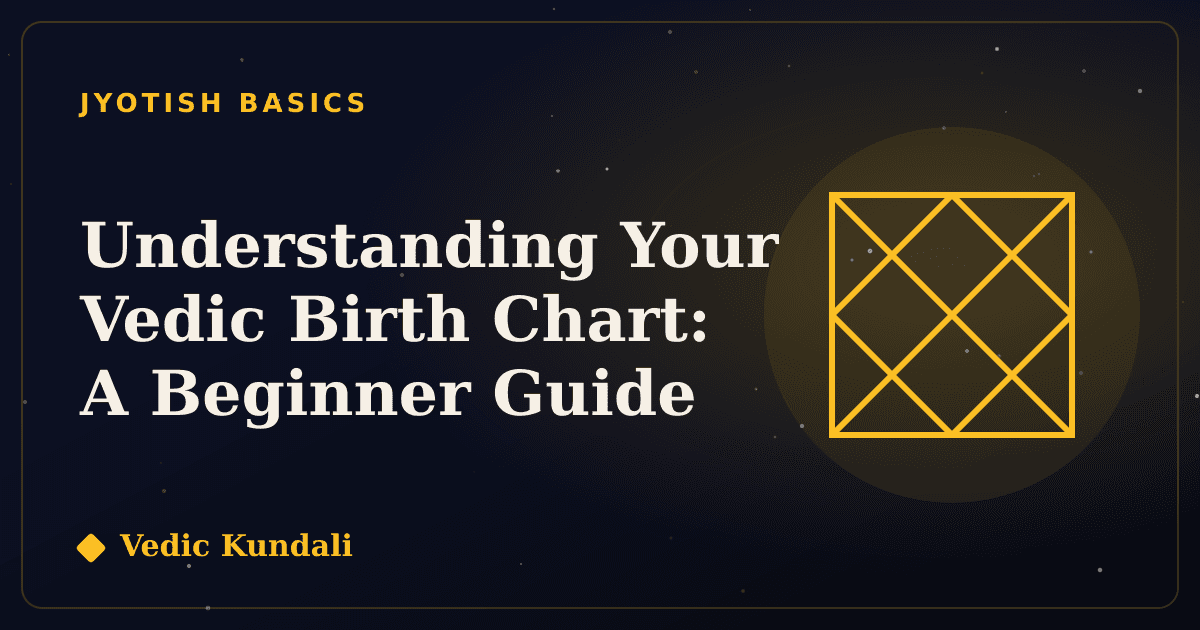
In North India the chart is drawn as a diamond. The shape never changes, the house positions never move, and the signs rotate into it depending on what was rising on the eastern horizon when you were born.
Three things are worth noticing straight away. Rahu and Ketu are always exactly opposite, six houses apart. Shani is marked retrograde. And Mangal, sitting in the 10th, throws its gaze onto three other houses rather than affecting only the one it occupies.
The twelve houses
Each house, or bhava, governs a department of life. This is the vocabulary everything else is built on, so it is worth learning properly rather than looking up each time.
| House | Sanskrit | Governs |
|---|---|---|
| 1st | Lagna, Tanu | The self, body, appearance, vitality, overall direction |
| 2nd | Dhana | Wealth, speech, food, immediate family |
| 3rd | Sahaja | Courage, effort, siblings, short journeys, skill |
| 4th | Sukha | Home, mother, property, vehicles, peace of mind |
| 5th | Putra | Children, intelligence, education, creativity, past merit |
| 6th | Ripu | Enemies, debt, disease, daily work, competition |
| 7th | Kalatra | Marriage, partnership, business, dealings with others |
| 8th | Ayur | Longevity, sudden change, inheritance, research, the hidden |
| 9th | Bhagya | Fortune, dharma, father, teachers, long travel |
| 10th | Karma | Career, status, public role, action in the world |
| 11th | Labha | Gains, income, networks, elder siblings, fulfilled wishes |
| 12th | Vyaya | Expenditure, foreign lands, isolation, sleep, liberation |
Houses are grouped, and the groups carry real weight in a reading. The kendras (1, 4, 7, 10) are the pillars of a chart. The trikonas (1, 5, 9) are the houses of fortune and are considered the most auspicious. The dusthanas (6, 8, 12) are the difficult houses. The upachayas (3, 6, 10, 11) improve with time and effort, which is why even malefics do well there.
The nine grahas
Jyotish uses nine grahas, not ten planets. There is no Uranus, Neptune or Pluto, and the two extra bodies are not planets at all.
| Graha | English | Signifies | Owns |
|---|---|---|---|
| Surya | Sun | Soul, father, authority, vitality | Simha |
| Chandra | Moon | Mind, mother, emotions, memory | Karka |
| Mangal | Mars | Courage, energy, siblings, conflict | Mesha, Vrishchika |
| Budha | Mercury | Intellect, speech, trade, calculation | Mithuna, Kanya |
| Guru | Jupiter | Wisdom, wealth, children, dharma | Dhanu, Meena |
| Shukra | Venus | Love, beauty, comfort, marriage | Vrishabha, Tula |
| Shani | Saturn | Discipline, delay, labour, longevity | Makara, Kumbha |
| Rahu | Rahu | Desire, ambition, obsession, the foreign | None |
| Ketu | Ketu | Detachment, insight, liberation | None |
Rahu and Ketu are the lunar nodes, the mathematical points where the paths of Surya and Chandra cross. They have no body, which is why they are called chhaya grahas, the shadow grahas, and they are the reason eclipses happen.
The three placements that matter most
Your Lagna, the ascendant. The sign rising on the eastern horizon at your birth. In Jyotish this is more important than your Surya sign, because it sets the entire house structure. Change the lagna and every graha lands in a different house, which changes the whole reading. It shifts roughly every two hours, which is why an accurate birth time matters so much. The lagna lesson walks through it.
Your Chandra rashi, the Moon sign. The mind, emotions and instincts. Vedic astrology gives Chandra primary importance for prediction: dashas are calculated from it, and every transit forecast is counted from it. When a rashifal says "your sign", it means this one.
Your Surya rashi, the Sun sign. The soul, father, authority and vitality. It matters, but far less than the two above, and it is usually the sign before your Western sun sign.
A reading that only mentions your Surya sign is not a Vedic reading. The ascendant guide explains why the lagna carries so much more weight.
How a chart is actually read
Beginners tend to look up isolated placements. Real reading is sequential, and the order matters:
- Find the lagna and note its lord. The strength and placement of the lagna lord describes the person's overall direction.
- Judge each graha's dignity. Is it exalted, in its own sign, in a friend's sign, or debilitated? A graha's dignity decides how much of its promise it can deliver. The strength lesson covers this.
- Read the house it sits in, and remember it also rules one or two other houses. A graha carries the affairs of the houses it owns into the house it occupies.
- Add drishti. Every graha aspects the 7th house from itself. Mangal also aspects the 4th and 8th, Guru the 5th and 9th, Shani the 3rd and 10th, and the nodes the 5th and 9th. See drishti explained.
- Note conjunctions. Two or more grahas in the same sign blend into one force, and some combinations form named yogas.
- Only then, look at timing.
Timing: the Vimshottari dasha
This is what makes Jyotish different from most systems. A chart shows what is promised. The Vimshottari dasha shows when it arrives.
It is a 120-year cycle in which each graha rules a period of fixed length: Ketu 7 years, Shukra 20, Surya 6, Chandra 10, Mangal 7, Rahu 18, Guru 16, Shani 19, Budha 17. Your starting point is set by the nakshatra your Chandra occupied at birth, which is why your janma nakshatra is calculated so precisely.
A well-placed graha gives its best results during its own dasha. A weak or afflicted one gives its problems then. This is why two people with similar charts have completely different decades, and why no honest reading skips it. The dasha guide covers the full system.
Where to go next
If you want to learn this properly rather than look things up, the Astrology 101 course runs in order from what Vedic astrology is through the twelve rashis, the nine grahas, the twelve houses, the lagna, grahas in the houses, planetary strength, planetary friendships and finally drishti.
Generate your free Janma Kundali to see your own lagna, Chandra rashi, all nine grahas with their dignities, and the dasha you are running right now. Everything above is easier to learn on your own chart than on a sample one.