
Two of the most powerful forces in a Vedic chart are not planets at all. Rahu and Ketu, the lunar nodes, have no physical body, no light of their own, and no mass you could weigh, yet they shape desire, obsession, fear and liberation more than almost anything else in a kundali. They are also the reason eclipses happen. Ask a traditional astrologer why the Surya (Sun) and Chandra (Moon) go dark, and the answer is the same one given for thousands of years: Rahu and Ketu swallow them. This guide explains what the nodes really are, the story behind them, the astronomy that matches the myth almost exactly, and what they mean when they sit in your birth chart.
The points that are not planets
Vedic astrology counts nine grahas, and the last two, Rahu and Ketu, are different from the other seven. The Surya, Chandra, Mangal (Mars), Budha (Mercury), Guru (Jupiter), Shukra (Venus) and Shani (Saturn) are real bodies in the sky. Rahu and Ketu are points, mathematical intersections, which is why they are called Chhaya grahas, the shadow planets. They cast influence without casting light.
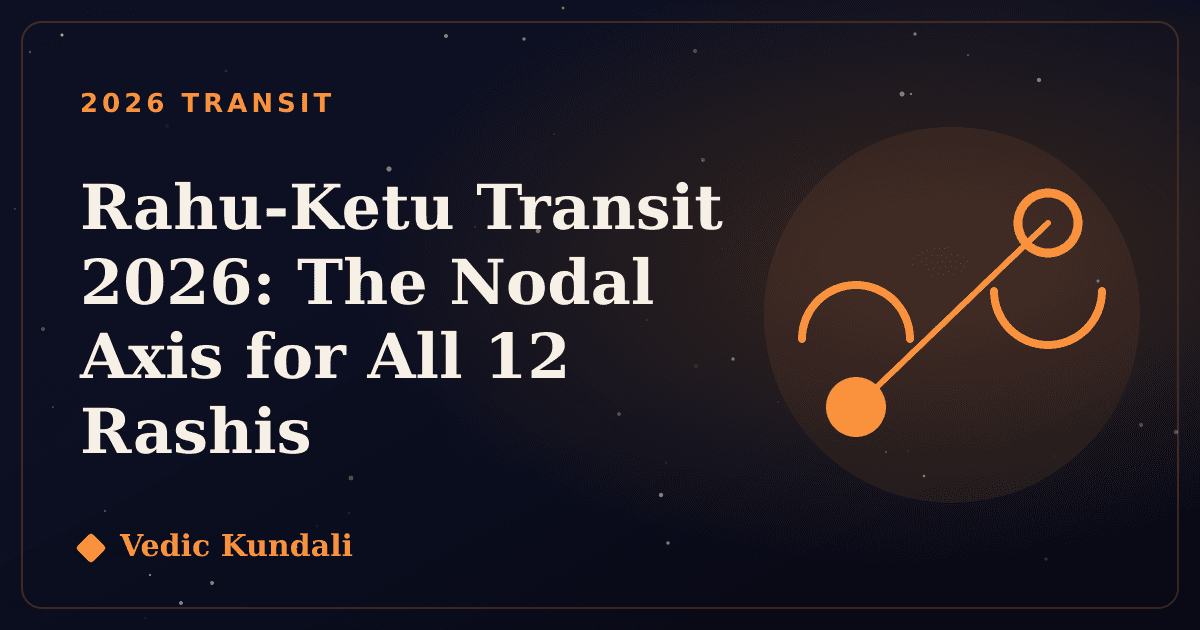
Because they are always exactly opposite each other, they form an axis that cuts the chart in two. Wherever Rahu sits, Ketu sits in the sign directly across from it. This axis is one of the most important features an astrologer reads, because it describes the deepest pull of a life, what the soul is reaching for through Rahu and what it is quietly releasing through Ketu.
Rahu and Ketu are always exactly opposite each other, six houses apart, because they are the two points where the Chandra's path crosses the Surya's. The chart below shows that axis.
What the lunar nodes actually are
Here is the astronomy, and it is worth understanding because it makes the mythology click into place. The Surya appears to travel along a path in the sky called the ecliptic. The Chandra travels along its own path, tilted about five degrees to the Surya's. Two tilted circles can only cross at two points, and those two crossing points are the lunar nodes. Rahu is the north node, the point where the Chandra crosses going north. Ketu is the south node, where it crosses going south.
The nodes are not fixed. They slowly drift backward through the zodiac, taking about eighteen months to move through each sign and roughly eighteen years to circle the whole chart. This is why the Rahu and Ketu transit is watched so closely. When the nodes change sign, the pressure points of the whole world shift with them.
Why eclipses only happen at the nodes
Now connect the two paths. A solar eclipse needs the Chandra to pass exactly between the earth and the Surya. A lunar eclipse needs the earth to pass exactly between the Surya and the Chandra. Both can only happen when the Surya and Chandra line up along the same line, and that line only exists at the nodes, the two places where the Chandra's path meets the Surya's. Away from the nodes the Chandra passes above or below the Surya and there is no eclipse. At the nodes the alignment is exact, and the light is cut off.
So eclipses do not happen at random. They happen at Rahu and Ketu. Every solar and lunar eclipse in history has taken place at one of the two nodes. The ancient astronomers saw this pattern clearly, long before modern instruments, and they gave it a face.
The story of Svarbhanu
The mythology comes from the Samudra Manthan, the churning of the ocean of milk, one of the great stories of Hindu cosmology. The devas and the asuras churned the ocean together to draw out amrita, the nectar of immortality. When the nectar finally appeared, Vishnu took the form of Mohini, an enchantress, and began serving it only to the devas so that the asuras would not become immortal and unstoppable.
One asura, named Svarbhanu, was clever. He disguised himself, slipped into the row of devas, and took a sip of the nectar. The Surya and the Chandra, seated nearby, recognised the imposter and alerted Vishnu. But it was too late. The nectar had already reached Svarbhanu's throat, so his head could not die. Vishnu cut him in two with the Sudarshana Chakra. The immortal head became Rahu and the immortal body became Ketu.
From that moment Rahu and Ketu carried one burning grudge, against the Surya and the Chandra, the two who exposed them. Forever after, they chase the luminaries across the sky, and whenever they catch one, they swallow it. That swallowing is the eclipse. Because Rahu is only a head with no body, the light soon slips out again, and the Surya or Chandra returns. It is a story about a wound that never heals, told across the sky on a schedule astronomers can predict to the minute.
Why the myth and the science agree
What is striking is how neatly the story maps onto the astronomy. The nodes are exactly where eclipses occur, and the myth places the two eclipse demons at exactly those points. The eternal chase matches the constant backward drift of the nodes. The head that swallows and then releases matches the temporary nature of an eclipse. The ancients were doing real observational astronomy and wrapping it in a story that made the pattern memorable and meaningful. Both layers are true at once, one as mechanism and one as meaning.
Why eclipses arrive in pairs
The nodes explain another pattern the ancients noticed. Eclipses do not come one at a time and scattered through the year. They come in seasons. Roughly every six months the Surya reaches one of the two nodes, and for a few weeks the alignment is possible. In that window you usually get a solar and a lunar eclipse within about two weeks of each other, a matched pair, because the Surya is near one node and the Chandra reaches the opposite node half a cycle later. This is why eclipse dates cluster, and why our guide to the eclipses of 2026 reads them in seasons rather than as single events. It all follows from the simple fact that eclipses live at the nodes.
The same story across the world
What is fascinating is that many cultures, watching the same sky with no contact between them, reached for the same image. In China the eclipse was a dragon eating the Surya, and people would make noise to scare it off. Norse myth told of wolves chasing and swallowing the Surya and Chandra. Across the ancient world the eclipse became a creature that devours the light and then lets it go. The Vedic version, the severed serpent Rahu and Ketu, belongs to this wider human response to a startling event. The shared picture is a reminder that these stories began as careful observation, dressed in the language of myth so the pattern would be remembered and passed on.
Why the nodes feel karmic
There is a reason astrologers speak about Rahu and Ketu in the language of karma. Because Ketu is the tail, the part left behind, it is read as the past, the skills and habits you arrive with already mastered. Because Rahu is the head, straining forward with endless hunger, it is read as the future, the unfamiliar territory the soul is here to explore. The axis between them becomes a line of travel across a life, from what is finished on the Ketu side toward what is unfinished on the Rahu side. This is why the nodes are treated as the most soul level points in the chart, and why their houses and signs describe the deep direction of a life rather than its surface details.
What Rahu and Ketu mean in your chart
In a birth chart the nodes are read as a single axis of desire and detachment. Rahu is the head that swallows without a stomach, so it is never satisfied. It stands for craving, ambition, obsession, foreign things, technology, and the hunger to experience whatever it touches. Wherever Rahu sits is the area of life you are pulled toward with an almost restless force, the place you overreach and eventually master.
Ketu is the headless body, so it acts without wanting. It stands for detachment, past-life mastery, spirituality, sudden loss and the drive toward moksha. Wherever Ketu sits is an area you feel you have already done, where you hold back, and where letting go brings peace. The two together describe the central tension of a life, grasping on one side and releasing on the other.
Because the nodes eclipse the luminaries in the sky, they also do something similar in the chart. When Rahu or Ketu sits with the Surya or the Chandra, it can cloud that light. This is the Grahan or eclipse yoga, and it can bring intensity, confusion or unusual gifts to the soul or the mind, depending on the rest of the chart. It is one reason the nodes are treated with such respect.
The nodal axis and Kaal Sarp
The nodes are also the boundary that forms one of the best known conditions in Jyotish. When all seven of the other planets fall on one side of the Rahu and Ketu axis, the chart is said to carry Kaal Sarp Dosh, the serpent that swallows the chart. That yoga is really just another expression of the same idea, the two halves of the serpent, head and tail, bottling up the rest of the sky between them.
Are Rahu and Ketu evil?
It is easy to read all of this and decide the nodes are bad news. They are not. Tradition classes them as malefics, but that word means testing, not evil. Rahu is the engine of worldly achievement. Almost every story of a person who rose from nothing to something has a strong Rahu behind it, because Rahu is the hunger that refuses to accept limits. Ketu, for all its losses, is the planet of genius and deep insight, the reason some people carry a skill that seems to come from nowhere. The nodes ask for maturity, and they can bring confusion or obsession when handled poorly, but a well placed node is one of the most powerful helpers in a chart. Read them with respect rather than fear, and they become allies.
How to read your own nodes
If you want to understand your own Rahu and Ketu, start with the axis. Find which houses they occupy and which signs they fall in, then read them as a pair. Ask what Rahu is pulling you toward and what Ketu is asking you to release. Notice whether either node sits with the Surya, Chandra or the ascendant lord, because that colours the soul, the mind or the self directly. The nodes reward this kind of honest, paired reading far more than a simple good or bad label, because they are the part of the chart that deals with your deepest wanting and your deepest peace.
Frequently asked questions
Are Rahu and Ketu real planets? No. They are the two points where the Chandra's orbit crosses the Surya's path, called the lunar nodes. Vedic astrology treats them as shadow planets because they carry strong influence without being physical bodies.
Why do Rahu and Ketu cause eclipses? Eclipses can only happen when the Surya and Chandra line up at the nodes, which are Rahu and Ketu. That is why every eclipse in history has occurred at one of the two nodes, and why tradition says the nodes swallow the luminaries.
What is the difference between Rahu and Ketu? Rahu, the north node, is the head, and it stands for desire, ambition and craving. Ketu, the south node, is the body, and it stands for detachment, spirituality and letting go. They always sit opposite each other.
What does it mean if Rahu or Ketu is with my Surya or Chandra? This is called Grahan or eclipse yoga, where a node clouds the light of a luminary. It can bring intensity and unusual insight to the soul or mind, with the exact result depending on the rest of the chart.
Want to see where your Rahu and Ketu axis falls? Create your free Vedic birth chart and read your nodes in under a minute. Where to go next
- Full profiles: Rahu and Ketu.
- The nodes joined to other grahas: Guru and Rahu, Surya and Ketu, Chandra and Rahu.
- Why the nodes aspect like Guru: drishti and planetary aspects.
- Where they sit this year: the Rahu and Ketu 2026 guide and the 2026 eclipses.