
Few terms in Vedic astrology frighten people the way Kaal Sarp Dosh does. Search the phrase and you will find pages promising ruin, endless struggle, and expensive rituals to escape it. We want to do the opposite here. Kaal Sarp Dosh is a real yoga with a clear definition, and once you understand what it actually is, most of the fear falls away. This guide explains what forms it, the twelve types, what it genuinely tends to do in a life, and why so much of what is written about it is exaggerated.
What Kaal Sarp Dosh actually is
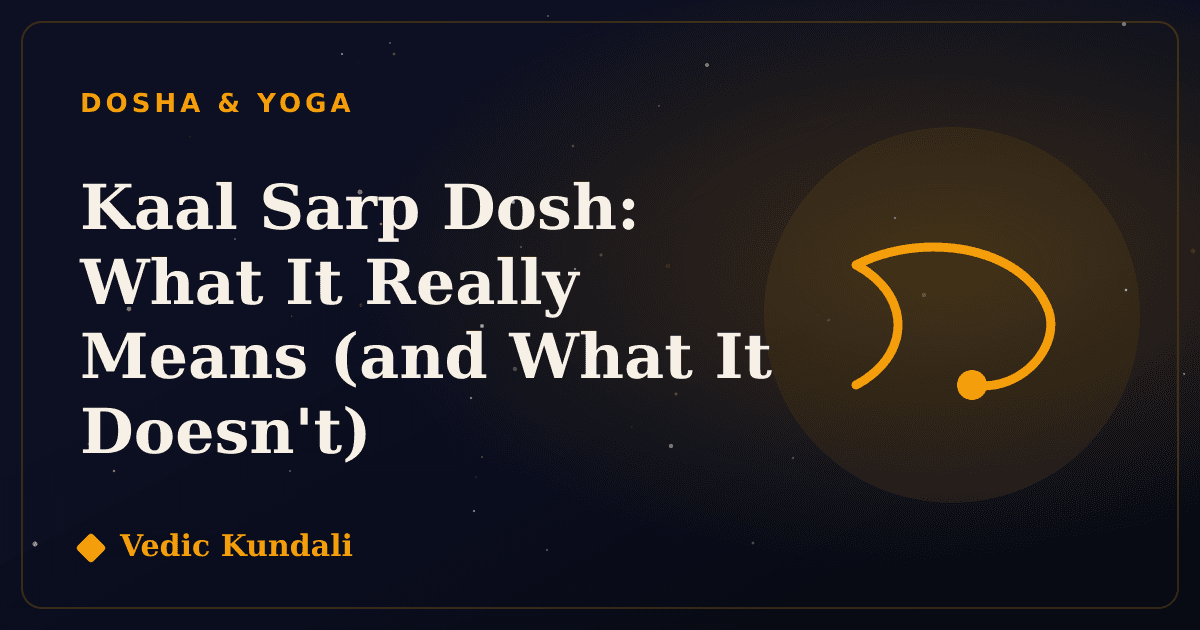
The definition is simple. Kaal Sarp Yoga is formed when all seven of the main planets, the Surya (Sun), Chandra (Moon), Mangal (Mars), Budha (Mercury), Guru (Jupiter), Shukra (Venus) and Shani (Saturn), sit on one side of the Rahu and Ketu axis. Rahu is the head of the celestial serpent and Ketu is its tail, and when every other graha is caught between them, the chart is said to be swallowed by the snake, which is where the name comes from.
That is the whole condition. Rahu and Ketu are always exactly opposite each other, so they cut the chart into two halves. If all seven planets fall in one of those halves, you have Kaal Sarp. If even one planet sits outside the axis, the yoga is partial or broken, and its effect is much milder.
The chart below shows the pattern in its clearest form. Every graha sits on one side of the Rahu and Ketu axis, with nothing on the other side. That hemming in is the whole definition of the yoga.
Why it is far more common than people think
Here is the first thing the fear articles never tell you. Kaal Sarp is not rare. Because it only depends on planets clustering on one side of a moving axis, a meaningful share of charts carry it in full or partial form. If it were the curse it is sold as, a large slice of the population would be doomed, and they plainly are not. Plenty of successful, happy, well known people have this yoga. That alone should lower the temperature.
The twelve types of Kaal Sarp
The yoga takes its name and flavour from the house Rahu occupies. There are twelve named types, one for each bhava Rahu can sit in.
- Anant (Rahu in the 1st): intensity around the self, identity and health.
- Kulik (Rahu in the 2nd): swings in wealth, family and speech.
- Vasuki (Rahu in the 3rd): ambition and effort, often strong for courage and communication.
- Shankhpal (Rahu in the 4th): restlessness at home and around the mother and property.
- Padma (Rahu in the 5th): ups and downs in education, children and creativity.
- Mahapadma (Rahu in the 6th): a fighter's chart, strong against enemies, debts and disease.
- Takshak (Rahu in the 7th): intensity in marriage and partnerships.
- Karkotak (Rahu in the 8th): interest in the hidden, sudden events and transformation.
- Shankhachur (Rahu in the 9th): an unconventional path in belief, luck and the father.
- Ghatak (Rahu in the 10th): a driven, unusual career, sometimes with a hard climb.
- Vishdhar (Rahu in the 11th): big but unstable gains and networks.
- Sheshnag (Rahu in the 12th): a pull toward foreign lands, solitude and spirituality.
Notice that several of these, Vasuki and Mahapadma in particular, are read as strong placements. The serpent is not only a threat. It can concentrate energy into one area of life with unusual force.
What it genuinely tends to do
Strip away the drama and Kaal Sarp has a recognisable signature. Because every planet is bottled up between Rahu and Ketu, life can feel like it moves in intense phases rather than a smooth line. There are often delays early on, a sense of pushing against something invisible, and then breakthroughs once the person stops fighting their own nature. Many people with this yoga describe a life of two halves, a struggling first act and a stronger second one.
It also tends to sharpen focus. With the whole chart pulled to one side, energy is not scattered. That is why the yoga shows up so often in driven, self made people. The same pressure that feels heavy in youth can become a real engine later.
Why most of what you read is exaggerated
This is the honest part. Kaal Sarp Dosh has become an industry. It is easy to frighten someone with a snake and a curse, and then sell them a costly ritual at a temple to remove it. We do not prescribe those remedies, and we would gently warn you against anyone who leads with fear and a price tag.
Three facts keep it in proportion. First, the yoga is common, so it cannot be the catastrophe it is painted as. Second, its strength depends entirely on the rest of the chart. A Kaal Sarp with well placed, dignified planets and a strong lagna lord behaves very differently from one with weak, afflicted planets. Third, a single planet outside the axis, or a benefic aspect from Guru, softens the whole thing. A serious astrologer reads all of that before saying a word about severity.
Full versus partial, and why it matters
The single most useful distinction, and the one most fear articles skip, is between full and partial Kaal Sarp. A full Kaal Sarp needs every one of the seven planets strictly between Rahu and Ketu, with none sitting exactly on the axis or spilling to the other side. The moment one planet breaks out, you have a partial Kaal Sarp, sometimes called a broken or leaking yoga, and its grip is far looser.
That breakout planet matters enormously. If a strong benefic like Guru or Shukra is the one sitting outside the axis, it acts like a release valve, giving the chart an easy channel that the pure yoga lacks. Many charts labelled Kaal Sarp by a quick glance are in fact partial, and reading them as a full curse is simply wrong. This is one more reason to have the chart looked at properly rather than trusting a scary headline.
The degree distance also counts. A planet a whisker inside the axis is barely contained, while one sitting in the middle of the bottled up half is fully caught. Two charts can both be called Kaal Sarp and feel completely different because of these details.
How to actually work with it
If your chart carries Kaal Sarp, the useful response is not fear, it is understanding. Look at which house Rahu sits in, because that is where the intensity concentrates. Check the dignity of your planets and whether any sit outside the axis. Notice the honest pattern of delays followed by breakthroughs, and plan for the long game rather than expecting everything at once. When the tradition speaks of remedies for a heavy Kaal Sarp, that is a conversation for a qualified astrologer who can weigh your whole chart, not a fixed prescription from a web page.
Frequently asked questions
Is Kaal Sarp Dosh really that bad? No. It is common, its severity depends entirely on the rest of the chart, and many successful people have it. The fear around it is largely commercial.
How do I know if I have it? All seven main planets must sit on one side of the Rahu and Ketu axis. If one planet is outside, it is partial. The simplest way to check is to generate your birth chart and look at where the planets fall relative to Rahu and Ketu.
Does Kaal Sarp go away? The yoga is fixed in the birth chart, but its felt intensity usually eases with age, especially after the first major life phases. Many people report their thirties and beyond feeling far smoother than their twenties.
Which Kaal Sarp type is good? Vasuki and Mahapadma, with Rahu in the 3rd and 6th, are often read as strong, since Rahu does well in those upachaya houses. As always, the rest of the chart decides.
Want to see whether your chart carries this yoga, and how strong it really is? Create your free Vedic birth chart and read your Rahu and Ketu placements in under a minute. Where to go next
- The two grahas that define it: Rahu and Ketu.
- When the nodes join other grahas: Guru with Rahu and Chandra with Rahu.
- How the nodes aspect the chart: drishti and planetary aspects.
- The nodes in transit this year: the Rahu and Ketu 2026 guide.