
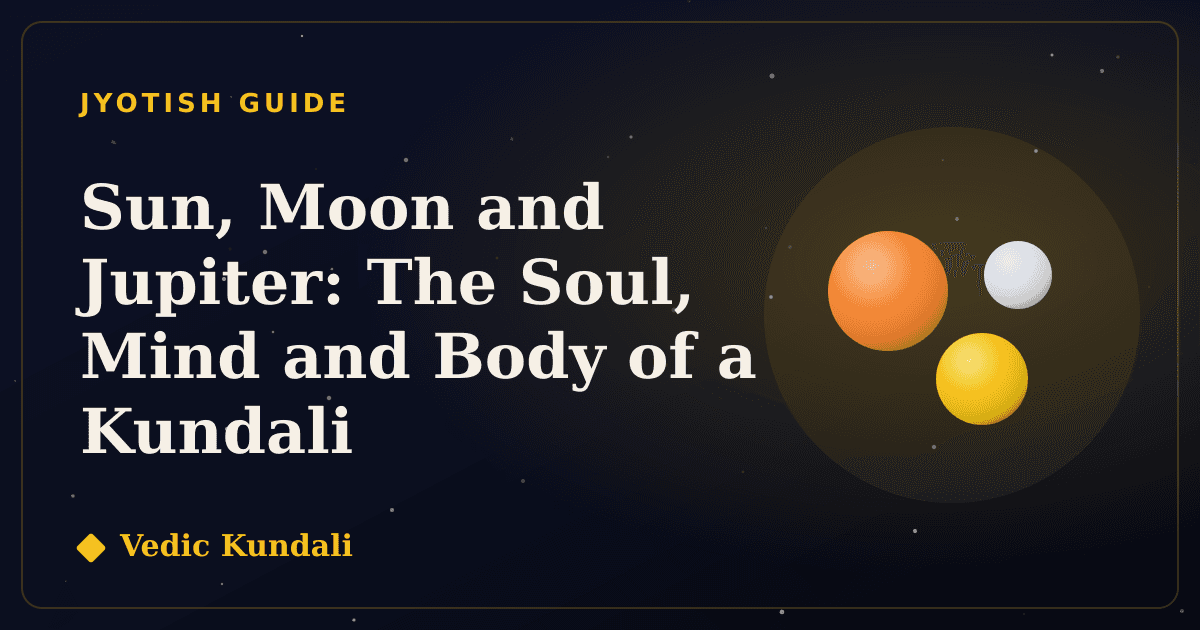
A birth chart has nine planets, but they do not carry equal weight. Three of them form the core of who you are, and a good astrologer reads these first before anything else. The Surya (Sun) is your soul, the Chandra (Moon) is your mind, and Guru (Jupiter) is your wisdom and life force. Between them they describe your spirit, your inner world, and the intelligence that guides both. This guide explains what each of the three governs, why they matter more than the rest, and how to read them together as the foundation of a kundali.
Why these three lead the chart
Every planet in Jyotish signifies real things, but the Surya, Chandra and Guru sit at the top of the order for a reason. The Surya and Chandra are the two luminaries, the givers of light, and classical texts call them the king and queen of the chart. Guru is the great benefic, the natural teacher, and the significator of the soul's growth. Where the harsher planets test you and the faster planets add detail, these three set the tone of the whole life. If they are strong and well placed, a chart has a solid centre, even when other parts of it struggle.
The three are easiest to read side by side. In the chart below Surya sits in the 10th, Chandra in the 4th, and Guru in the 1st, so the soul, the mind and the expanding principle each occupy a different angle of life.
The Surya, your soul and vitality
The Surya, called Surya, is the Atma karaka in the natural order, the significator of the soul. It stands for your core self, the steady I am underneath every role you play. It also rules vitality and health, the father, authority, confidence and your standing in the world. A person with a strong Surya tends to have a clear sense of who they are, good energy, and a natural pull toward leadership.
The Surya is not a soft planet. Its light is fierce, and it burns as much as it warms. When it sits close to another planet that planet is said to be combust, its qualities scorched by the Surya's heat. So the Surya asks for respect. Handled well it gives dignity and purpose. Handled poorly it turns into pride and a need to dominate. In the chart, the house the Surya occupies shows where you most want to shine and be seen, and where your sense of self is worked out.
The Chandra, your mind and emotions
If the Surya is the soul, the Chandra, called Chandra, is the mind. This is where Vedic astrology parts ways with the Western tradition most clearly. In Jyotish the Chandra is often treated as the single most important planet in the whole chart, more important day to day than even the Surya, because it rules the manas, the emotional and perceiving mind through which you actually live every moment.
The Chandra governs your feelings, your moods, your sense of comfort and safety, the mother, and the general public. Its condition describes your inner weather, whether you feel steady and nourished or anxious and unsettled. So much rests on the Chandra that two core features of Vedic astrology are built from it. Your Janma Nakshatra, the birth star that shapes your character, is the Chandra's nakshatra. And your entire life timeline, the Vimshottari dasha, is counted from where the Chandra sits at birth. A strong, waxing, well placed Chandra gives emotional stability, warmth and popularity. A weak or afflicted Chandra shows a restless, easily shaken inner life that needs conscious care.
Guru, your wisdom and life force
The third pillar is Guru, called Guru or Brihaspati, the teacher of the gods. Guru is the great benefic, the planet that expands and protects whatever it touches. It stands for wisdom, higher knowledge, ethics and faith, and it is the significator of the jiva, the living spirit and the life force that keeps the body growing and healthy. In the body it rules the liver, fat and the process of growth itself, which is why it carries a strong link to physical wellbeing and vitality.
Guru is the guiding intelligence of the chart. Where the Surya gives the soul and the Chandra gives the feeling mind, Guru gives the judgment that steers them, the sense of meaning, values and long view. It is also the classical rescuer. When Guru aspects a stressed part of a chart with its wide and generous gaze, it softens the damage and adds grace. A strong Guru tends to give optimism, good fortune, respect, healthy children and a life with a clear moral compass. A weak Guru shows poor judgment, a shaky sense of meaning and a tendency to overreach.
Soul, mind and body, read together
Put the three together and you have the inner constitution of a person. The Surya is the soul that gives you a centre. The Chandra is the mind that colours every experience. Guru is the wisdom and life force that helps the soul and mind grow toward something worthwhile. A chart where all three are strong describes a person who knows who they are, feels their life deeply, and has the judgment to make something of it.
One honest note on the word body. The physical body itself is read mainly from the first house and the ascendant, not from these three planets alone. But the Surya rules your vitality, the Chandra rules the fluids and the emotional health that keep the body well, and Guru rules its growth and protection, so the three together carry much of your living constitution. Between the soul, the mind and the life force, they describe the person living inside the body far more than any other trio in the chart.
The luminaries and the eclipse
There is a deeper reason the Surya and Chandra are read as a pair. They are the two lights that get eclipsed, and in Vedic astrology the shadow planets Rahu and Ketu are the ones that swallow them. This carries straight into the chart. When a node sits with the Surya, it can cloud the soul, and when a node sits with the Chandra, it can cloud the mind. This is the Grahan or eclipse yoga, and it is one of the clearest examples of how a sky pattern becomes a personal meaning. It is also why an astrologer looks at the Surya and Chandra not only for their own strength but for what sits near them.
New Chandra and Full Chandra in a chart
The relationship between the two luminaries at birth matters a great deal, and it shows up in the phase of the Chandra. A person born near a new Chandra, with the Surya and Chandra close together, has a Chandra weakened by the Surya's glare, called an Amavasya birth, which often gives a private, self reliant nature that has to build emotional confidence over time. A person born near a full Chandra, with the Surya and Chandra opposite each other, has a bright, strong Chandra that tends to give emotional fullness and an easy connection with others.
Classical astrology reads this so closely that it names special conditions around the Chandra. When benefic planets sit on either side of the Chandra it forms protective combinations that steady the mind, and when the Chandra stands alone with no planets beside it, tradition calls it a lonelier placement that feels its ups and downs more sharply. None of this appears in a sun sign horoscope, which is one more reason the Chandra deserves the first look.
Judging the three by dignity
Strength is not only about which house a planet occupies. Each of the three has signs where it is exalted and at its best, and signs where it is debilitated and struggles. The Surya is exalted in Mesha (Aries) and weak in Tula (Libra). The Chandra is exalted in Vrishabha (Taurus) and weak in Vrishchika (Scorpio). Guru is exalted in Karka (Cancer) and weak in Makara (Capricorn). A soul planet, mind planet or wisdom planet sitting in its exaltation gives a clear, reliable version of what it signifies, while the same planet in its fall gives a quieter, more tested version that has to work harder for the same result.
This is why two people can both have a strong looking Surya by house and still differ, because one has it dignified by sign and the other does not. Reading the three by both house and sign is how you move from a rough sketch to an honest picture.
How the three interact
The relationships between these planets matter as much as their individual strength. The Surya and Chandra are the parents of the chart, and when they sit in harmony a person tends to feel whole, with the will and the feelings pulling the same way. When they clash, there can be an inner split between what you want and what you feel. Guru's aspect on either luminary is one of the best things that can happen in a chart, since it brings wisdom to the soul or calm to the mind.
Their placement by house tells the story in plain terms. The Surya shows where you seek to shine, the Chandra shows where you seek comfort and belonging, and Guru shows where fortune and growth come most easily. Reading those three houses together gives you a fast and honest sketch of a life before you look at anything else.
What a weak version looks like
It helps to know the honest signs that one of the three needs attention, because that is where a reading earns its keep. A weak Surya tends to show up as low confidence, a shaky sense of self, or a strained relationship with the father and with authority. A weak Chandra shows as mood swings, worry, poor sleep and a mind that struggles to feel safe. A weak Guru shows as poor judgment, a loss of faith or meaning, and a habit of expecting more than a situation can give.
None of these is a sentence. A planet that is weak by sign can still be lifted by a good house, by the aspect of a strong Guru, or simply by conscious effort over the years, since the mind and the sense of self are not fixed. The value of spotting a weak point is direction. It tells you where the chart, and the person, has the most to gain from patience and care. That is a far more useful thing to know than a flat good or bad verdict.
How to read your own core three
Start with the Chandra, because in Jyotish it leads. Find its sign, its nakshatra and the house it occupies, and judge whether it is strong and unafflicted. Then read the Surya for the state of your soul and vitality, and the house where you most want recognition. Then read Guru for your wisdom, your fortune and the parts of the chart it protects with its aspect. If these three are sound, the chart has a strong centre to build on. If one of them is weak, that is usually the first place a thoughtful reading, and a thoughtful life, goes to work.
Frequently asked questions
Which is the most important planet in Vedic astrology? The Chandra is often treated as the most important for daily life, because it rules the mind and because both the birth nakshatra and the dasha timeline are calculated from it. The Surya and Guru follow closely as the soul and the guiding wisdom.
What do the Surya, Chandra and Guru represent? The Surya represents the soul, vitality and the self. The Chandra represents the mind, emotions and comfort. Guru represents wisdom, growth, fortune and the life force. Together they form the inner core of a chart.
Why is the Chandra so important in Jyotish? Because it rules the mind through which you experience everything, and because two central tools, the Janma Nakshatra and the Vimshottari dasha, are both built from the Chandra's position at birth.
Which planet rules the body? The physical body is read mainly from the first house and the ascendant. The Surya, Chandra and Guru rule vitality, emotional health and growth, so they shape the living constitution rather than the body's shape alone.
Want to see how strong your Surya, Chandra and Guru are? Create your free Vedic birth chart and read your core three in under a minute. Where to go next
- Each graha in full: Surya, Chandra and Guru.
- The three together in one sign: the Surya, Chandra and Guru conjunction.
- In pairs: Surya and Chandra, Chandra and Guru, which forms Gaja Kesari.
- How the three are read as karakas: the nine grahas.